
Private Labels vs Brands: Are Retailers Quietly Eating FMCG’s Lunch?
Private labels are no longer the cheap alternative on the shelf—they’re quietly becoming serious rivals to national FMCG brands. This article breaks down how retailer-owned brands are gaining ground on price, quality, shelf visibility and margins and what traditional manufacturers need to do to stay relevant.
FMCG
What’s on Your Shelf?
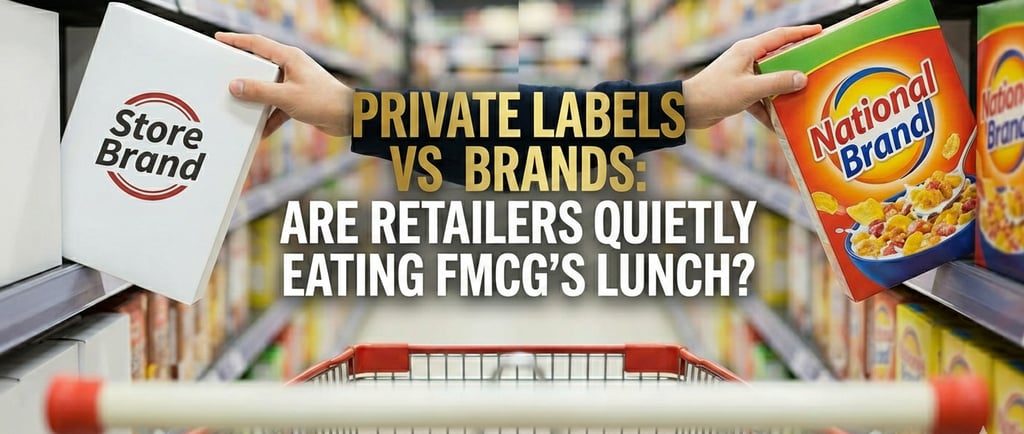
When you walk into a supermarket looking for a pack of flour or sugar, on the shelf, you often see two options. One is familiar, a long-established brand name with glossy packaging. The other has the store’s own label, simpler, often cheaper, but hard to ignore. Over the last few years, a growing number of shoppers are reaching for that store-brand alternative and that shift is not a coincidence.
Private labels (also called store brands or retailer-owned brands) are no longer just low-cost substitutes. They are turning into serious competitors for traditional FMCG brands, reshaping the market of how consumers shop and how retailers strategize.
What Are Private Labels — and Why Are They Surging?
Private labels are products sold under a retailer’s own brand name, instead of a third-party or “national” brand. Retailers like supermarkets, large grocery chains or online marketplaces manufacture these products themselves. This gives them control over pricing, margins and supply chain.
For a long time, private labels were seen as low cost, generic alternatives. But today’s private labels have evolved. They often match and sometimes surpass, national brands on quality, design, packaging and value, all while often costing less.
Retailers view private labels as a strategic asset and not just a discount alternative. By controlling production, pricing and presentation, they can differentiate themselves, build customer loyalty and improve profit margins.
The Numbers: Private Labels Gaining Real Ground
The growth trajectory of private labels:
According to the latest edition of the EY Future Consumer Index (India, 2025), 52% of Indian consumers say they are switching to private labels. Moreover, 70% believe these products meet their needs and also offer quality compared to leading national brands.
Many consumers report increased visibility of private labels; people say they notice more private-label offerings where they shop and see these items placed at prime “eye-level” shelf positions.
Globally too, private labels are doing well. A recent report shows that in the U.S. in 2024, private label sales rose by 3.9% (to a record $271 billion), while national brands grew by only 1%.
Across the 17 European grocery markets, private-label penetration is even stronger, the value share is around 39% across Europe, the unit share (the percentage of actual physical products sold) is significantly higher in many key countries, often above 40% and in some cases, such as Switzerland, over 50%.
These numbers show that private labels are no longer fringe players; they are shifting to central to modern retail strategies.
Why Retailers and Consumers Are Embracing Private Labels
For Consumers: Value + Quality + Convenience
Better value for money: Most customers feel private labels offer nearly the same quality but at lower cost. Many of them say, store brands help them save money.
Comparable quality: Consumers believe private labels meet their needs as effectively as national brands.
Increased trust and acceptance: The stigma of “cheap/low quality” associated with store brands is fading. As the retailers are investing more in private labels, for better packaging, improved supply chains, quality control etc, the customers are more willing to rely on them.
For Retailers: Control, Margin and Differentiation
Higher margins: By sourcing, manufacturing and selling directly, retailers often enjoy higher profit margins than from reselling third-party brands.
Shelf-space advantage: Retailers can control where their private-label products are displayed, often placed at eye level or in prime positions to maximize visibility.
Customer loyalty: Private labels help create a distinct identity for the retailer. As the new private labels are being associated with value and reliability and not just low price due to which the retailers have built stronger relationships with shoppers.
What This Means for Traditional FMCG Brands
The rise of private labels poses some serious threats and challenges for traditional FMCG brands:
Erosion of brand loyalty: As consumers become comfortable with private labels, brand loyalty weakens. Many people now prioritize value and price over legacy brand names.
Pressure on pricing & margins: Legacy brands may feel forced to compete on price, which can squeeze their margins. Long-standing brands built on heritage, advertising, brand equity might find it harder to justify premium pricing.
Need to demonstrate real differentiation: Brand owners must now invest more in genuine innovation, not just superficial “reformulations” or marketing. But consumers are increasingly sceptical some people may feel like “brand improvements” feels like cost-cuts rather than genuine innovation.
Competition across more categories: Private labels are no longer just in staple categories. From beauty and personal care to frozen foods, home care, even fashion and apparel; private label presence is growing fast. That extends the competitive pressure across many product segments.
In short, traditional FMCG players can no longer rely on brand prestige alone. The playing field is shifting.
Could Retailers Be “Quietly Eating FMCG’s Lunch”?
The phrase may sound dramatic — but there are growing evidence that’s exactly what’s happening. By introducing strong private labels, retailers are gradually capturing market share once held by big-brand FMCG firms.
Global and Indian trends both point to rising private-label adoption.
Retailers are using their privileged position like shelf space, supply chain, pricing control; to position private labels not as backup, but as first-choice for many consumers.
For many product categories, especially everyday staples (staple foods, home care, basic personal care), private labels are becoming mainstream and sometimes preferred over the brands.
Thus, in many ways, retailers are rewriting the rules of FMCG retailing. Shifting power from traditional manufacturers to store owners. That shift, if sustained, could fundamentally change the FMCG landscape.
What Can FMCG Brands Do — Adapt or Fade Away?
For traditional FMCG brands, the rise of private labels isn’t doom, but the brands need adaptation…
Re-focus on differentiation beyond packaging
· Brands should Invest in real product innovation like better formulations, new formats, premium or niche offerings.
· It should emphasize unique value propositions, (sustainability organic ingredients, superior taste, health benefits, convenience) elements that private labels often struggle to match at scale.
Reinforce brand identity and trust
· Use storytelling, heritage, trust, brand ethics; aspects that can’t be easily replicated by generic store brands.
· Build deeper engagement and loyalty among customers.
Leverage premium and niche segments
· Premiumization: As consumers get more value-oriented but also quality-conscious, premium or specialty offerings might win the customers back.
· Focus on segments where brand trust and reputation matter like cosmetics, health-oriented products or products with strong identity value.
This transformation may look quiet — but its impact is loud, it’s reshaping supermarket shelves and consumers shopping baskets everywhere.
If private labels continue growing at this pace, how long before they stop being alternatives and become the default choice…?
© 2026 Avrax Consulting Pvt. Ltd. All rights reserved.
• Strategy & Advisory
• Execution Engine
• Market Expansion
• Corporate Governance
info@avrax.in
+91 7081145716
Better Business Decisions Begin With Better Strategy.

