
How Banks Are Reducing Fraud and Scam Losses With AI (What’s Real, What’s Not)
AI is improving how banks detect suspicious activity, reduce false positives and intervene in real time. The strongest results come when technology, operations and governance work as one system.
FINTECH
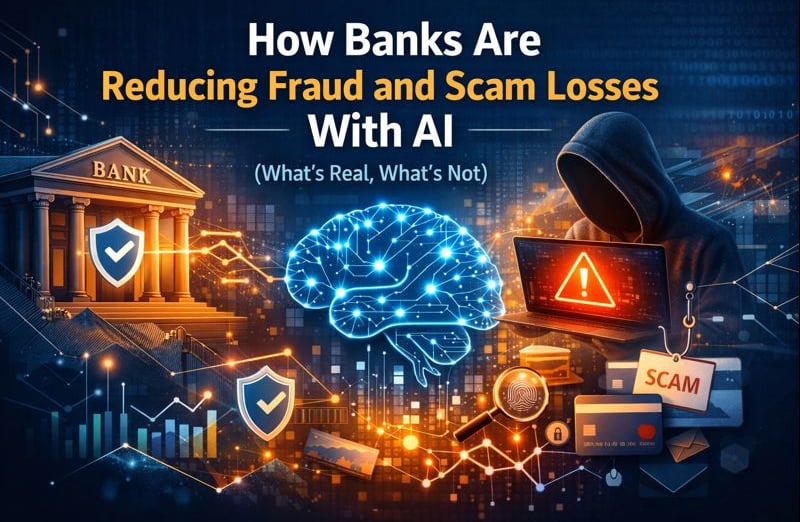
Fraud is no longer a “rare exception” in banking. It’s a daily operating reality—spanning card fraud, account takeovers, mule networks, impersonation scams and payment redirection. And the problem isn’t only the money lost. It’s the customer friction that comes with trying to prevent it: declined payments, repeated verification, delayed transfers and long support calls.
For years, banks leaned heavily on rules—if-then logic like “flag if amount > X” or “block if geography looks unusual.” Rules still matter. But on their own, they struggle in a world where criminals adapt in days, not months.
That’s where AI is changing the economics of fraud prevention.
Not because it’s “magic,” but because it helps banks make better, faster decisions with less noise.
Why traditional fraud controls hit a ceiling
Rules-based detection breaks down for three predictable reasons:
1) Fraudsters move faster than rules
A static ruleset is always reacting to yesterday’s fraud. By the time a rule is updated, the attack pattern has often shifted.
2) Rules create too many false positives
If you tighten rules to catch more fraud, you also catch more legitimate customers. That leads to:
Higher alert volumes
Overloaded review teams
More customer declines and drop-offs
3) Fraud signals are no longer simple
Modern fraud doesn’t show up as a single “bad” transaction. It shows up as patterns:
A new device + unusual session behaviour
A cluster of accounts interacting with the same network
A sequence of actions that looks “human” but isn’t
Rules are not designed to connect these dots at scale.
What AI actually improves in practice
AI in fraud detection is most effective when it supports real-time decisioning, not just post-facto reporting.
1) Better signal, not just more signal
AI models can combine many inputs—behavioural signals, device context, network links, transaction velocity—into a single risk score that’s more nuanced than thresholds.
That enables smarter actions:
Approve low-risk activity instantly
Step up verification for mid-risk cases
Block or hold high-risk attempts
2) Meaningful reduction in false positives
A major operational win for banks is reducing “noise.”
When AI reduces unnecessary alerts, teams stop chasing harmless activity and focus on real threats. This also improves customer experience because fewer genuine transactions get interrupted.
A public example: HSBC has reported materially fewer false positive cases (60% fewer) in parts of its financial crime detection work—an illustration of how AI can reduce alert volume when deployed with the right data and controls.
3) Faster adaptation to evolving attacks
AI systems can be retrained and tuned more frequently than manual rules—especially when feedback loops are built in (investigator decisions, confirmed fraud outcomes, new scam typologies).
This is particularly valuable in scam-heavy environments where fraud patterns shift rapidly.
Real-world outcomes: what “good” can look like
It’s important to separate marketing claims from measurable results.
A strong example comes from Australia: CommBank has publicly reported that customer scam losses reduced significantly from their peak period—by 76% since peak losses (reported around late 2022 / early 2023 depending on the reporting cut). That’s not “AI alone,” but AI-driven alerts, controls and detection are part of the broader toolkit used to drive the reduction.
The key takeaway: when banks combine AI with the right operational design, the impact can be substantial.
The part most banks underestimate: AI is not the solution—execution is
AI models don’t run a fraud program. People and process do.
Banks that get real results usually have three things in place:
1) Real-time intervention capability
If your fraud program relies on end-of-day review, you’re fighting with one hand tied. The value of AI is highest when you can act quickly:
Stop suspicious transfers before they complete (where possible)
Trigger step-up checks instantly
Slow down risky journeys without blocking everyone
2) Strong feedback loops
Models improve when they learn from outcomes. That means:
Clean tagging of confirmed fraud vs non-fraud
Clear investigator decision capture
Discipline around monitoring drift and retraining schedules
3) Governance that matches the risk
AI can be powerful, but banks need guardrails:
Explainability where required (especially for adverse actions)
Audit trails for high-risk decisions
Bias and fairness checks in decisioning flows
Clear ownership across risk, compliance and fraud ops
Where AI delivers the highest ROI
In most banks, the fastest returns show up in:
Alert reduction / investigator productivity (less noise, better prioritisation)
Account takeover detection (behavioural + device signals matter here)
Scam prevention interventions (timely warnings, friction added only when needed)
Network-level detection (identifying mule clusters and coordinated patterns)
A realistic conclusion
AI will not eliminate fraud. But it is increasingly central to reducing both:
Losses (by catching higher-risk events earlier) and
Friction (by reducing false positives and unnecessary blocks)
The banks seeing the biggest gains aren’t simply “using AI.” They are building end-to-end fraud decisioning systems where models, people, controls and customer journeys work together.
If there’s one simple rule to remember, it’s this:
AI improves fraud outcomes most when it changes decisions in real time—not when it just creates more dashboards.
© 2026 Avrax Consulting Pvt. Ltd. All rights reserved.
• Strategy & Advisory
• Execution Engine
• Market Expansion
• Corporate Governance
info@avrax.in
+91 7081145716
Better Business Decisions Begin With Better Strategy.

